Devolver Digital’s ongoing support for indie developers occasionally leads to a new game hitting the scene that brings with it a unique perspective and intriguing game design.Inscryptionis one such game, with an initial fantasy premise-turned-mystery wrapped up in acard game. It quickly becomes a gripping metafictional thriller that bleeds into the real world, elevating it a step above other titles in the genre.
Developed and released in late 2021 by Daniel Mullins Games,Inscryptionhas earned awards and nominations across the board. However, were it not for the game’s move away from just a traditional card-based style, it might never have garnered the attention it enjoys today. Like many games currently cropping up on the indie scene, metafiction is a huge trend in game design.Spoilers forInscryptionahead.
RELATED:New Devolver Digital Game Gunbrella Announced at Nintendo Indie Showcase
Inscryption’s Origins
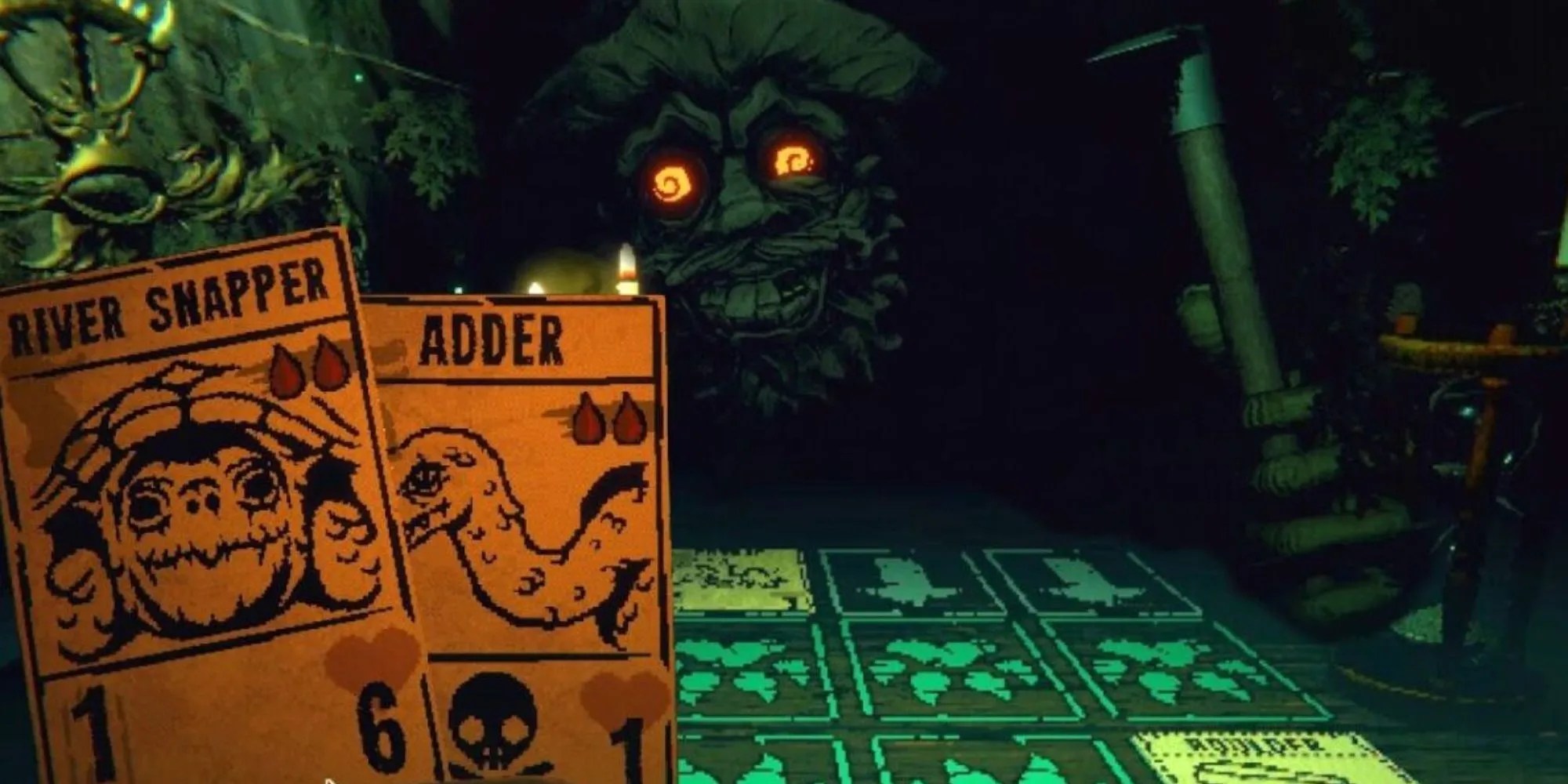
Inscryptionbegan life as a card game entered into the Ludum Dare game jam, with a prototype making its way to itch.io for the public to sample. The basis was drawn from the game jam’s theme, “Sacrifices must be made,” and so core mechanics revolved around the sacrifice of cards in order to summon and play stronger cards out of their deck. After seeing a positive response to the game, developer Daniel Mullins took the concept further.
New gameplay elements were introduced to complement the existing card game, and this gradually built up its story. For example, the card game takes place inside an escape room, sitting face-to-face with the antagonist. The player is welcome to stretch their legs at any point in the game to explore the room and solve its puzzles. Some puzzles require knowledge or experience acquired while playing the card game, and others require the player to make certain plays to influence the surrounding room. The complexity deepens whensentient playing cardsbegin hinting at more going on beneath the surface.

When Inscryption Gets Meta
Once the player successfully escapes the cabin,Inscryptionthe game suddenly diverts and breaks through the fourth wall. It’s revealed that the player’s game is footage of a playthrough created by Luke “TheLuckyCarder,” a would-be YouTube personality who embodies the trend of channels dedicating themselves to card games like thePokemon TCG. It is revealed thatInscryptionis not meant to be a video game, but a card game created by the fictional company Gamefuna, and Luke has stumbled across an unreleased version of the game buried in the middle of nowhere.
Hints had been scattered throughout the game that point toInscryption’ssecret metafiction, such as the player only being able to “Continue” rather than start a new game, and the aforementioned sentient cards being revealed to be previous bosses called “Scrybes” from the originalInscryption. While remaining true to its card-based gameplay, the story escalates into an even greater thriller, unraveling a mystery behind OLD_DATA and its ominous influence, withInscryptionseemingly being designed to contain it. The game moves through variousretro graphical styles and genres, becoming a dungeon-crawler in some portions and a point-and-click in others.

With real-world recordings of Luke, the involvement of Gamefuna, and the player’s progress toward uncovering the truth, what started as a seemingly quirky and dark card game evolves into a Lovecraftian struggle against an unknown, corrupting power that affects the Scrybes and Luke himself.Inscryption’scomplexity and intertwined metafictionpushed the envelope of more typical card games that it might be compared to, such asHearthstone, Gwent, orArtifact.
RELATED:18 Awesome Collectible Card Games (That Aren’t Yu-Gi-Oh!)
Inscryption’s Not The First Game to Break The Fourth Wall
WhileInscryptiontred new ground within its genre, it wasn’t the first to get metafictional. In 2017,Doki Doki Literature Clubmasqueraded as one of many anime dating sims in the visual novel style, and took the gaming scene by storm thanks to its sharp turn into psychological horror. The parallels here are important, asDoki Doki Literature Clublikely would not have received the praise it did without breaking the fourth wall and spooking players.
Without the metafictional elements,Inscryptionis a charming game at face value that may not have had much substance. Only when its added layers are brought in does the game begin to get more engaging, especially given its focus on narrative unlike othercard games that primarily concern themselves with competitive play.
Inscryptiongrabbed players' attention, and its metafictional experience leaves the door wide open for a sequel to pick up where the first gameleft off. There’s no official word from Mullins about coming back to the fantastical world that has been constructed forInscryption, but fans are hungry for more, and it would be a shame to seean award-winning indie gameremain a standalone title.
